Tiqti Sud Chapel & Center

Tiqti Sud Chapel & Center

About Me

My photo
Called to be a Lay Missioner with the Franciscan Mission Service in Bolivia

Monday, July 4, 2011

Church Interiors Photo Essay


Side altar

I just wanted to share some pictures of church interiors that I have taken over time. Only the one in Tiqti has the modern look (see previous blog entry for photo). I need to take one of the San Carlos Church as it mixes old with new.


;
Church at Plaza Principal Tarata


Detail of the altar above.


The Church at the Franciscan Retreat Center at La Angostura

This was said to be a replica of the church in Copacabana, that I wasn't allowed to photgraph. I believe just the statue of the virgin is the replica because, the church was far more impressive.


Sunday, May 29, 2011

Somos Una Familia Parroquial Unida En Mision


(Above)Inside of Tiqti Chapel

The title to this post translates roughly to: We are a Parish Family United in Mission. It is a phrase we use to describe my parish, San Carlos, here in Bolivia. Last year we were focused on the idea that we are all on mission. I may have shared this in an earlier post, or email newsletter, or just in individual letters.

This theme was more deeply focused and examined on an all day retreat that about 100 people from my parish participated in last year in May. We traveled to the Franciscan Retreat Center in Tarata, which is about an hour away. We participated in workshops that put us together in mixed groups from the parish. Our final workshop we joined with people who have similar work, and prepared statements on what we were willing to commit to for the next year.


Lintel of Doorway into Retreat Center

A week or so later we had a special mass we were all pledged to work as missioners in the parish. I wrote at the time of the irony that I felt to have traveled all this way to be a missioner and yet everyone in my parish was now missioners!

The third Sunday of Lent this year, culminated the year of focus on mission. All the churches in the diocese were invited to the International Fair Grounds in Cochabamba for a "Fiesta of Fraternidad". All the churches were to suspend their masses for the day and everyone was invited to mass at the fairgrounds. I would guess that there are over 500,000 Catholics in the Cochabamba area. They planned for 7,000 people to come and over 10,000 were in attendance. Crowd wise I felt it was far larger than SOA protests!

We were invited to spend the whole day celebrating and creating community. It was a bit like a Clearwater Revival (without famous artists!) There were areas for folk dance performances, theatre performances, concerts, kids play areas, Adoration of the Blessed Sacrament, and more. Each church staked out an area to gather their people, some just to eat lunch, others their personal celebrations, dances and music. There was even a mariachi band that played one song, of the Mexican Folk Dances I learned to dance to out in Colorado!

There were various contemporary catholic rock bands and it was great to see so many folks dancing about and singing to the songs. It amazed me to see so many different groups of nuns; I believe a majority of who were in their habits.

Archbishop Tito was the main celebrant at the mass, there was a representative from the Vatican present. Padre Honny from my days in Sacaba was on the main altar too! There were dozens of other priests concelebrating the mass. It was the quietest Bolivia mass I ever went to. You could hear children [playing in the distance, and the birds twittering in the trees.

Archbishop Tito besides giving a sermon related to the Sunday readings, which focused on thirst of all types and incarnation of Christ, made connections to the theme he wishes we would work towards in the coming year(s). He challenged us within our parishes to create various groups that would create space for fraternity, and within those brother/sisterhoods to be communion or body of Christ to each other. We are to move into the 1st phase of the pastoral plan that orients our road to permanent mission of our parishes.

During the mass a group of people "brought symbols of the seven gifts of the Holy Spirit" forward. I was waiting for the first symbol, when someone raised up a styrofoam cut out of the Holy Spirit in the form of a dove. Then seven people released seven white doves. They flew round, split into groups, and one group of about 4 doves returned to the rooftop of a tent near the altar, guess they didn't want to miss the rest of the mass!

All in all I think it was a great day that should be repeated at least once a year. Positive notes, absence of commercialism, alcoholic beverages, and usual Bolivian trash (the young folks were picking up what was dropped.) People really seemed to enjoy themselves and there wasn't time to see everything!

Sunday, May 22, 2011

Dogs and a Splash of Humor


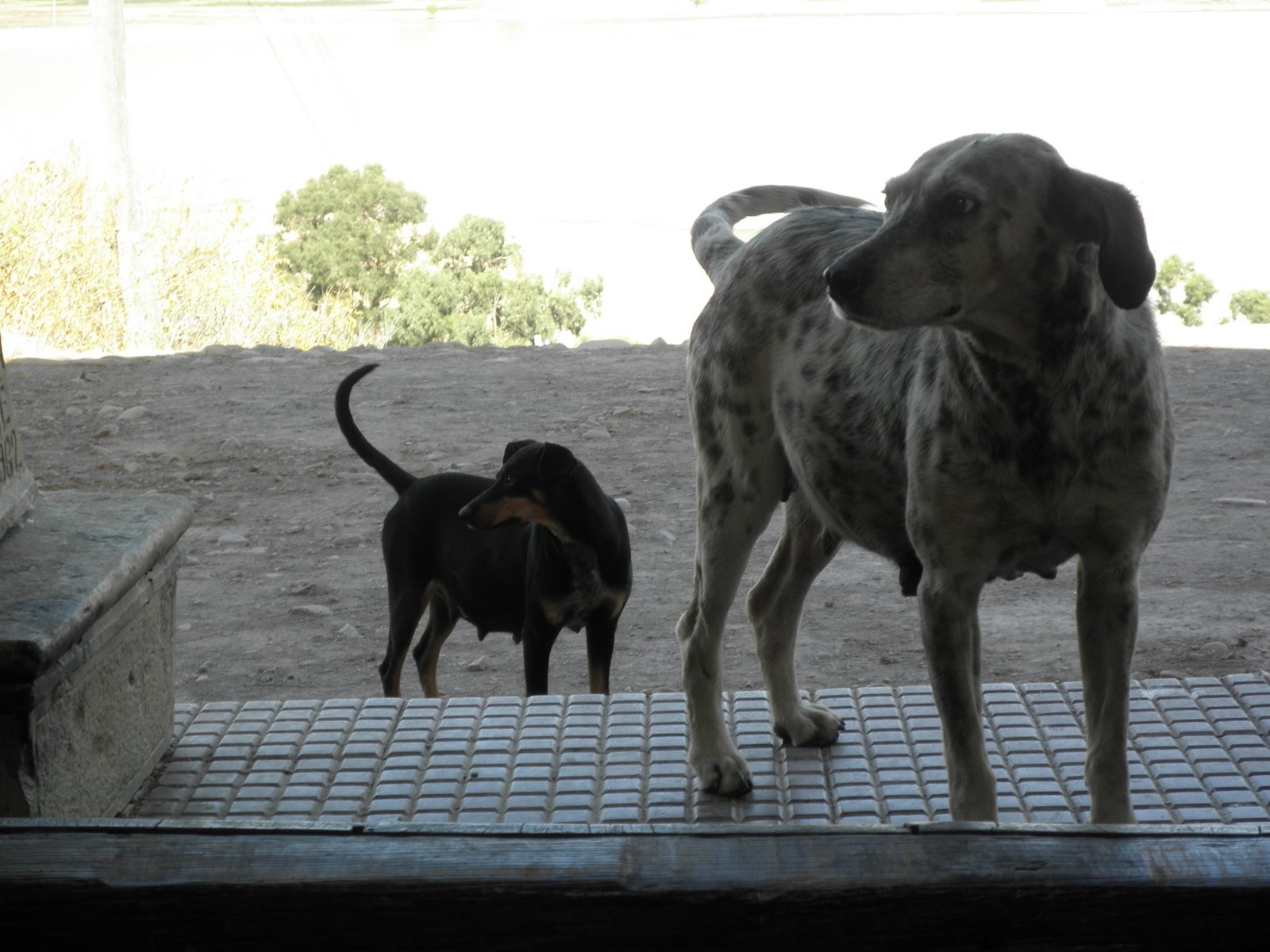
Stories about animals and kids can be amusing. Here are a couple of vignettes. I tried to get a picture of dogs trying to come into the church. Some Sundays they go right up to the altar or take a tour during mass.


Here are two of the dogs that live at my center (there are four). The front one is Donny, the one behind I call Gramps. They guard the place. We don't need doorbells, because they bark whenever anyone comes to the gate. Though sometimes I think they bark at passing clouds or butterflies!!

When I am home (and working) I usually leave a door open. As I was passing from one room to another, something flickered in my peripheral vision. The rooster had come in through the office to the living room. I opened the living room door to shoe him out, but as he is supposedly blind, that wasn't easy. In those brief moments he was able to leave a few "presents". He has been on my hit list for eating, my pea, watermelon and flower plants. I hear that he is going to market tomorrow! (and he won't be making any purchases, wink wink!)

I will try to insert another photo in here later of the chicken that likes to say her prayers. She thankfully went to her birth home, because she ate even more plants, and left even more presents for the Virgin Mary.


Always save the best for last. One of the kids in the after school program, has a secret access to fish, the very small ones you find in a pond. I have no idea where he gets them, and all the other kids are fascinated with them. He is quite generous, and shares them with anyone, who has a little cup of water.

Dona Severina's son who is in first grade was very excited to get some. The next day we asked him where his fish were, and he proudly staed that he had put them in the water tank, so they would have room to swim and grow! Note that this is our water tank for drinking, cooking & bathing!! I couldn't stop laughing! So logical! Sure enough when we filled the water tank a few weeks later there were two larger fish swimming around. Sorry no photo, you just have got to believe!!

Tuesday, May 10, 2011

Retreat


In January of this year our program director Rhegan and FMS board member Fr. Joe came to Bolivia to guide us in retreat, and also visit our work sites and our Bolivian homes. We went to a retreat center within the city limits of Cochabamba, and yet it felt far away. The grounds were well kept, there was a beautiful chapel, we had simple rooms and hot water!! We even had flowered covered gazebos were we met sometimes and where we had had our final mass. See above picture.


Flowers at Retreat Center

We had morning and evening prayer, group discussions and reflection times. I will quote from one of the evening reflections sheets Rhegan prepared for us:

"As missioners we know that we do not possess God. We do not carry God to distant lands and peoples. Rather it is God who possesses us and sends us to peoples of our world."

"As missioners we seek to live simple lives. By stripping ourselves of all that is not essential, we strive to be free from possessions in order to be for God."

"As missioners we celebrate the lives and experiences of the people with whom we are sent. Their lives change us. We experience with them a celebration, a joy, and unity of life beyond our individual experience. We celebrate the fact that we are becoming one just as Jesus wanted us to be."


Some of our reflections focused on The Beatitudes and on Canticles. One exercise we were given for the retreat was to create a canticle. We were given art supplies and instructions. We were to present our canticles in our final gathering time. Our responses were as varied as we are each different. At the time my thoughts were very much on my location of living and work; Tiqti Sud. I drew the picture below and wrote the verses that follow the picture.


Bless the Lord, you hills of Tiqti:
Who look from various angles
as the City of Jerusalem,
when the golden light of sunset,
shines on your unfinished houses of adobe and brick.

Bless the Lord! You cacti who flower and bloom,
and give your fruit for free.

Bless the Lord! You water that drops upon the dry soil,
that collects to running torrents.

Bless the Lord! You sun of Tiqti,
lifegiving and parching.

Bless the Lord! You brown dry plants,
that with rain become luscious green plants.

Bless the Lord! Oh you animals of Tiqti,
foraging pigs, nibbling goats, barking dogs,
seeking sheep, quacking ducks, and pecking chickens.

Bless the Lord! Oh you small creatures,
ants laboring under a large leaf,
grasshoppers looking for grass,
spiders protecting,
dragonflies who stay the night,
and other crawly unnamed many legged friends.

Bless the Lord! You hills of Tiqti,
who not long ago held life of one sort.
Now you open your arms to the scars
inflicted by humans,
and still you cradle us,
the new life,
to live on your soil.

Bless the Lord! You hills of Tiqti! Bless the Lord!

Bless the Lord!

Monday, April 4, 2011

Inca Rock

Our last day of the pilgrimage, after mass, we visited the museum at the church at Copacabana. We waited a long time for a quick tour, our guide didn't say much, but the guide of the second group was full of information she wanted to share. I hung back at times to hear what she had to say. Again we were not allowed to take photos.

There were many artifacts from centuries earlier. Original chalices, vestments, altar clothes, paintings, altar vases and so on. Very little was labeled and was not very organized. (Items from 30 years ago mixed with items from 500 years ago. I noticed this trend in other museums.) There were a lot of silver and gold items. We came out into a beautiful cloistered garden adjacent to the church, where we did take pictures (none on my camera), it was a peaceful, prayful spot.

The whole trip I was able to spend time with different groups of people from church. I think because I didn't go with a particular group, it was easier for me to mix in and get to know different people. One night a couple of the church ladies asked me to join them for coffee.


After the museum, a group of young people were going exploring and invited me along. We arrived at Inca Head (above photo), which I assume was carved by a modern sculptor. I also thought it was our destination (we had already stopped at a small park.) No we were going somewhere else, we continued further up hill to the outskirts of town. We were going to climb a hill similar to the Stations of the Cross but on the other side of town.

It was nice they wanted me along, but now I thought I didn't want to slow them up. I am double the age of most of the group, and we needed to get back for lunch. I looked for ways to convince them I would stop and wait for them to come back down. They kept urging me on, and we discovered that we were not on the path about 1/2 way up the mountain. We had been bushwacking, well more like rock climbing, because we were using our hands, and there weren't many bushes!


At one of my rest spots, I took the above photo because it reminded me of the view from Mt Battie above Camden Harbour. Of course there are more boats in Camden! At my last resting spot, I was at it for a while, Jimena called me from slightly above, but more further around a cliff. She said I had to come because it really wasn't very far to go to see Inca Rock. It was nice that it wasn't on the top of the hill. Remember we are already at an elevation of 12,600 ft, so a hill feels a lot like a mountain.


Inca Rock is a lintel placed on two stones (see above, it is not the Easter Island type rock on the right!) Many of the stones at the top part of the hill stuck up like Stonehenge, though I don't think they were placed there like the lintel on Inca Rock. Jimena explained to me that this could be called punnishment rock. If one commited a "sin", a hand or a foot would be cut off. More sins or larger sins a whole appendange would be cut off, repeat offenders could have another hand/foot cut off..

Later someone told me that this rock was also a sacrificial rock, where humans were sacrificed. Could this be true too? The day before we were told only beautiful virgens were sacrificed. Oh what a blessing to be ugly! We made it back down the mountain in time for lunch, in record time becuase we followed the path the whole way! After lunch we cleaned, packed, and picked up snacks for the way home

Monday, March 28, 2011

Sacred Inca Ruins


We stopped at a port on La Isla del Sol, where we saw the reed catamaran Sailboat take off. There were a few residences, a hostel and a few eateries. The beach here was covered with pebbles, more like the cliff walk beach at Newport Rhode Island. The first photo shows the rock staircase that we climbed to the spring. Along the rock steps, the spring ran down in a little stream, and people stopped to drink the water.

The ancient Inca Springs located two thirds of the way up the hill, were used by Inca Priests to purify themselves before rituals. They would come to this place by boat, to purify and prepare themselves for rituals that were held in other locations. Only the most important people were allowed to come here. There were two different springs with different types of water, a mineral water and the other just regular spring water. The priest needed to bathe in both waters and drink from both. springs.


All our Catholic pilgrims did an abbreviated version, a cup of water from both and wetting their heads in both. The cautious missioner that I am, I drank three handfuls directly from the streaming water and passed three drenching handfuls over my head. I must admit that I later got a headache, so I don't know that I recieved a blessing, but maybe I cured something else... People also filled bottles with the water and I wasn't sure if it was to drink or use as a holy water.

As an aside, when people bless themselves with holy water here, they put handfuls on their heads, or sometimes the priest drenches them with holy water. In many churches here, after mass, the people go up to the altar and wait for the priest to bless them with holy water. For some it is not enough to get a sprinkle from afar, they need to get up close for a good dousing!


After the Inca Springs we got back into the boat and passed by the above ruins slowly. I don't think that we had time to unload the boats, explore and reload the boats. I don't have any information about these ruins.

After we stopped by some floating restaurants, where you could choose which trout you wanted slaughtered for your dinner. They were in cages in the water. We only stopped for a short time, but a few people did buy trout dinners. So many people wanted to see them kill and clean the fish, that the area of the float went inches under water, and people needed to move to other parts of the float to adjust. We headed back after to Copacabana, where lunch was waiting for us (5:00pm!!)

Monday, March 21, 2011

My Personal Pilgrimage on Boats in Lake Titicaca

Having worked on sailboats for various seasons in the mid 1990s. I was quite excited to see Lake Titicaca, which is the highest commercially navigable lake in the world. I think that it is the second largest freshwater lake in South America. Lake Titicaca is about 3,232 sq miles, average depth of 351 ft, with the deepest deepth of about 1,000 ft. To make a comparison, the land area of New Jersey is 7,419 sq miles.

When we crossed in ferry to the peninsula, we had to leave the bus and take small boats of 15-20 people to the other side. The bus was driven onto a ferry, which looked like a dock, or pierhead, or a gigantic raft. At one point in the middle of the channel the ferry bobbed up and down so much, I thought the bus wouldn't make it. Ours was the largest vehicle to cross at that time.


A week earlier two boats had collided and a couple of people drowned. The military police were out on our return crossing to make sure the boats were not over loaded and that everyone had a lifevest. The life jacket was very sketchy in my opinion and since I was the only one who knew how to put one on, I felt it but a joke (no safety talk on this boat). Though I know how to swim I put one on to show others, and to be able to help if there were an actual emergency.

Our second day we took a boat to Isla del Sol (the Island of Sun), the ride was almost two hours. When we arrived we basically went to the beach. There were soccer and volley ball games, some of us rolled up our pants and waded in the water. The campers on the beach (mostly foreigners) said the water was warm. Having worked sailboats in Maine, where water temps could fall under 60 F, I would consider this water cold!! After the soccer games some folks actually did swimm around.

What impressed me most in the boat ride and on the bus ride from the ferry to Copacabana were the proliferation of terraces, or terraced land. I had seen it before in Bolivia but not to this extent. It impressed me that so much land had been cultivated. I could only imagine the extent of the Inca Civilization. There were still working terraces that we passed by boat. The water temps in Lake Titicaca are said to remain the same year round, making it a great place to raise crops. Below is the best shot that I was able to get, but like the Grand Canyon it is hard to get a picture that truly represents what I saw.


After out time on the beach we boarded the boat again for a short cruise to another port on the island were we saw ancient ruins (stay tuned for next post for details) While we were there a reed catamaran set sail from the dock to head back to Copacanana. I hope to return some day to take a sail on that boat. The sailors also had long oars to halp get them out of port. The boats of old on Lake Titicaca were mostly made of reed. If you are in Washington DC you can see one of these reed canoes on display in the native American Museum in the main foyer.